Showing posts with label 1940s. Show all posts

Wednesday, October 31, 2012

Adam's Rib (1949)

Why it's here:
I was drawn to the Hepburn/Tracy pairing, knowing of their famous on- and off-screen chemistry and thought this one, with it's law drama and courtroom humor, might make a good choice.

Specs:
Over an hour and a half; black and white. We watched on a dvd from the library

Our family's average rating:
6.67

More about the film and our reaction to it:
Although both Katherine Hepburn and Spencer Tracy are great actors and this was probably a very relevant and witty film in its own time, it felt more than a bit dated to us.

Curious that Adam's Rib was our lowest rated film since The Lady Eve and I'm wondering if Adam and Eve just aren't where its at for us. . . . I'll be interested to see how All About Eve plays for us next week. . . .

I spent a fair amount of time wondering if I'd made a mistake introducing this material to my kid. The film starts with an attempted murder where a jilted wife follows her husband to another woman's apartment. The themes of adultery and spousal abuse are heavy and, by modern standards, pretty unsettling, though clearly meant to be light-hearted and played for comedy at the time. The film explores the ideas of how spouses mistreat one another and drive each other away. The plot twist comes from Tracy playing the prosecutor who is attempting to convict the murderous jilted wife while the prosecutor's wife, Hepburn, plays the private practice defense attorney who takes on the job of defending said murderous jilted wife.

The underlying marital problems of our defendant/victim couple are mirrored (or maybe prism-ed)  through the lawyers' own marriage as the case gets further along.

These are fairly adult and unpleasant themes dealing with the worst sides of a marriage; though, very loving and caring sides to marriage are shown as well. The film is very sexist by today's standards (though it plays as if meant to be a feminist message). All in all, though an interesting film and clearly well-acted, it is probably not best suited to family viewing.

Iconic shot:


Tuesday, October 30, 2012

The Noose Hangs High (1948)

Why it's here:
We'd seen the "Who's on First Routine" and found it hilarious. Why not try a whole movie with the comedy talents of Abbott and Costello.

Specs:
1 hour, 15 min; black and white. We watched this one on Netflix

Our family's average rating:
7.5

More about the film and our reaction to it:
The comedy of Abbott and Costello is extremely well-suited to modern, smart-alecky kids. My boys loved this. The humor is found both in fast-talking, smart dialog and also physical and visual  pratfalls and hijinks. As such, it hits on all cylinders for kids.  One of the funnier bits involves Abbott's character repeatedly putting on and taking off his pants. Another funny moment comes as Costello pulls a gag on a gangster thug by betting him that he, Costello, "isn't here" -- and actually managing to win the bet. You gotta see that.

The movie is simple of plot, but really delightful in that simplicity. It doesn't try to hard to be something it isn't -- it just showcases how funny these guy's are.

Considering some of the big-budget spectacles we've seen lately, this one just seemed basic and true and reminded me of the silent-era comedies we love, where the ability of a film to win you over was basically a function of the pure comic talent and not of film-making spectacle. It felt really good to watch a movie like this in 1948.

Iconic shot:

Monday, October 29, 2012

Easter Parade (1948)

Why it's here:
I guess, to see Judy Garland and Fred Astair. Seemed like an odd pairing

Specs:
An hour and 45 minutes; COLOR with a capital "C" -- I guess with all caps.
Supposedly set in 1912 :)

Our family's average rating:
6.88

More about the film and our reaction to it:
This serves as an extraordinary exposition of Technicolor. Half the point of making this film must have been to showcase "color" -- deep lush velvet and silk fabric drapes in every color, enormous bouquets of flowers, gowns with sequins and fringe, all overdone in the most saturated tones imaginable.

Even at age 50, Fred Astair moves like a dream on a cloud. He must be the most graceful man to have ever danced. As we watched his dance scenes with Judy Garland - who is a lovely dancer, but primarily a singer, we could see the difference with his top-notch dancing skills. He moved with total fluidity. On the other hand, Judy sang with complete power, skill, style and talent. Fred couldn't hold a candle to her pipes. The movie benefits, oddly enough, by allowing each to shine in their own way and help showcase the other's complementary talent.

The supporting roles were enjoyable as well. Peter Lawford and Ann Miller play the alternate love interests and, up until the end, my younger son and I were sure that Judy would end up with Peter, and Fred with Ann. Jules Munshin, an actor I'd never heard of, gives a wonderfully funny performance as a waiter. His description of how he makes the salad was comic genius.

Rounding out the film were awesome Irving Berlin songs, which are now resonating in our heads,  some incredibly elaborate sets, a very cool special (dance) effect where Astair moves in slow motion relative to the background dancers filmed at normal time. This movie had to have had a big budget and, all in all, was very enjoyable - though we would have enjoyed it a fair bit more had it been about 15 minutes shorter. I think it's rating must have dipped at least a 1/2 point by lasting just that bit too long!

It irked me to no end that the picture was set in 1912 when almost nothing about the film (other than an occasional car or telephone) looked anything like it belonged in 1912. Not the hairstyles, nor the clothes, nor the furnishings, the music, dance styles or the male/female relationships gave any impression of 1912. In fact, though the picture was released in 1948 I thought it had a very 1950s look and sound.

Iconic shot:


Thursday, October 25, 2012

Mr. Blandings Builds His Dream House (1948)

Why it's here:
Someone recommended this to my husband. Problem is, he doesn't remember who : ) So we know somebody thought it worth seeing and put it on the list.

Specs:
1 1/2 hours; black and white.

Our family's average rating:
7.13

More about the film and our reaction to it:
The film has a bit of a slow start as we explore Grant's feeling hemmed-in in his New York apartment. Grant, a big time Madison Ave. ad man (a dozen years before Mad Men is set) is frustrated with his urban life and convinced that moving out into the country will address what ails him, his wife (lovely Myrna Loy) and their two daughters. They set about building the house that will be an escape from it all. Unfortunately, every financial deal he undertakes blows up in his face. It's the makings of a "city slick meets country stubborn" tale and it ends up being a pretty good one.

The film is different than other Cary Grant films we've seen in that its a bit slower, sweeter and domestic. It is great to experience Grant as the straight man while Melvin Douglas, who I had not really seen before, hams it up as the hilarious wise-cracking lawyer/best friend. Loy, too, is a joy in the film and the performances of these three lift the film out of what might otherwise have been just mildly amusing, into something worth spending the time with.

The kids really got a kick out of the construction scenes -- especially seeing the steam shovel that looked just like Marianne (from Mike Mulligan) digging the basement, carpenters using hand saws and hammers, the awesome guy who dug the well, the odd little closet upstairs that people kept getting locked inside, and on and on.

In terms of a history/learning moment, it depicts the earliest migration of the upper class out of cities and into larger tracts of land in the suburbs in search of that little slice of paradise and is interesting for that reason as well. All of this adds up to an excellent film for family viewing, though not necessarily amazing cinema.

Iconic shot:


Thursday, October 18, 2012

Hamlet (1948)

Why it's here:
Our dip into Shakespeare. I really wanted the boys to see Laurence Olivier, widely regarded as the best actor of a generation, in this influential role.

Specs:
2 1/2 hours, black and white. We watched on a dvd from the library.

Our family's average rating:
7.67

More about the film and our reaction to it:
I wasnt' sure how the boys would take to full lenth Hamlet. They'd experienced some Shakespeare including having acted vignettes from his comedies, so we weren't totally unfamiliar with Shakespeare, but this was to be a big step into that world...  this was Hamlet -- not modernized, abridged or simplified; so I wondered.

Unnecessarily. In fact they loved it. No, they didn't understand every bit. I had to narrate a bit of the action and explain things here and there, but this didn't affect their abilty to appreciate the wonderful, clean rendition of the classic play. There is nothing distracting here to take you away from the underlying brilliance of the story. Just Shakespeare and excellent acting.

I loved this comment from a contemporary review in the New York Times, praising the just-released film:
[By being presented in the format of film rather than on the stage, Olivier's] Hamlet makes the play more evident by bringing it closer to you. The subtle reactions of the characters, the movements of their faces and forms, which can be so dramatically expressive and which are more or less remote on the stage, are here made emotionally incisive by their normal proximity. Coupled with beautiful acting and inspired interpretations all the way, this visual closeness to the drama offers insights that are brilliant and rare.
What a great point! It makes sense to capitalize on the natural closeness of film to really introduce your kids to Shakespeare, rather than going to see stage productions.  We talked about Olivier's performance as Hamlet and why it was so universally praised. We are not actors ourselves and we don't speak the "jargon" that makes talking about his talent easy, but we found him compelling. He just was this character. Totally believable. He conveyed such earnest, intense, intellect with the role. Incredible.

Iconic shot:

Wednesday, October 17, 2012

Life with Father (1947)

Why it's here:
We needed more William Powell. This one had the added bonus of Liz Taylor just a couple of years after National Velvet.

Specs:
2 hours; color. We could only find it on VHS tape from our library.
Set in Victorian England.

Our family's average rating:
7.75

More about the film and our reaction to it:
William Powell is the highlight of the film and is awesomely funny throughout. He had us in stiches with his out-of-touch, pompous dad, terrorizing the servants, criticizing his wife's relatives, ordering about his children, and generally blustering about. Best of all were his interactions with his wife (Irene Dunn) who somehow always came away with what she wanted. We couldn't quite tell if she was extra intelligent or extra ditzty, but either way, she managed to get the best of dad most of the time.

This film probably lasted about 20 minuteslonger than the plot required, but we didn't mind because of William Powell - I think we'd have happily watched him for another hour.

A side note is that the quality of the tape we watched was quite poor. The day after suffering through the weak color and staticky picture, we were flipping channels and saw that it was being broadcast on TMC! If you can catch it on dvd, or on television broadcast you might enjoy it more, but in any case, enjoy!

Iconic shot:

Monday, October 15, 2012

The Ghost and Mrs. Muir (1947)

Why it's here:
Combo love story and ghost story. How can you go wrong with that.

Specs:
Over and hour and a half, black and white.
Set at the turn of the century England

Our family's average rating on a scale of 1-10:
7.63

More about the film and our reaction to it:
Although the film is not a horror film or a thriller, and the "ghost" in the case ends up being very nice, audiences should know that before we get comfortable with our ghost, the movie is actually quite frightening. When Mrs. Muir is looking to rent a lonely seaside cabin, and it appears that the house is haunted, tension is intensionally played up and the film is sure to frighten some kids.

The scariness evaporates as soon as we get to know the ghost better. The "relationship" between him and our leading lady is wonderful and quirky enough to carry the movie. The acting is very good throughout, especially Rex Harrison as the ghost. Natalie Wood even appears as Mrs. Muir's young daughter.

One of the coolest things about this picture was seeing Palos Verdes, in LA, where the seaside cabin was filmed. So amazing, circa 1947, to see all that primo real estate empty -- and the area so remote. Crazy to think that any part of LA could have passed as the quaint English seaside. But it worked.

Iconic shot:

Sunday, October 14, 2012

Notorious (1946)

Why it's here:
Included as one of my all time favorite films.

Specs:
Just over an hour and a half, black and white. Available on dvd in a beautifully restored version with lots of special features.

Our family's rating on a scale of 1-10:
8.75

More about the film and our reaction to it:
In the commentary to the film, Alfred Hitchcock is quoted as explaining the difference between "surprise" and "suspense." A bomb unexpectedly going off, he says, causes surprise and you have the audience's reaction for a few short seconds. But, he says, if you first disclose that there is a bomb, allow the camera to show where it is, then, cut to a clock and film people chatting about stupid things, all the while the the viewer is thinking "look underneath the table! there's a bomb! don't just sit there chatting!" -- well, that's suspense and it can last for a long time.

In Notorious, suspense is everywhere and used so powerfully, that viewer can hardly breathe. One of the most powerful dramatic devices, for instance, is the camera showing the champagne bottles at the climatic party, fewer and fewer of them, and with each one gone, a growing likelihood that Claude Rains will have to go to the wine cellar. The brilliance of Hitchcock lies in his use of simple objects (like the key to the wine cellar) taking on so much meaning. Hitch can make a key an object of tension! I found it hilarious that after the movie, while cleaning up in the kitchen, I looked at the counter where my husband's key ring was lying and it gave me a real start!

The film is profoundly good both a thrilling spy story and a powerful romance. The briefest plot summary goes like this: Bergman plays Alicia, who's father is sentenced for treason at the start of the film. We learn that she is a devil-may-care party girl and does not share her father's politics. She is approached by the spy, Devlin (Grant), to do a job for the feds, infiltrating the organization that her father had been a part of. In doing so, she gets close to, and ultimately marries Alex Sebastian (Claude Rains).

Cary Grant and Ingrid Bergman are incredible stars and give profoundly great performances. Their relationship is nuanced, beautiful and heartbreaking. They are both loved by the camera and you can just gaze at their beauty for an hour and a half without needing more. But, there is so much more . . . On the spy story end, it is amazing how much tension and fear can be created when there is absolutely no violence, gore, terror or death shown on screen or even threatened. The script is fantastic, and the cinematography dramatic, meaningful and very beautiful. All aspects of the film seem to layer on top of the others to add to the experience. Even hairstyles and costumes are meaningful. Edith Head dressed Ingrid Bergman stunningly and so appropriate to the themes and drama.

Family viewing notes:
Although my 10 year old was impressed with the movie (its hard not to be), I would recommend this one for 13+ simply because the plot is too complex and the human emotion too grown up to really expect most children to follow or enjoy. On the other hand, because there is no real violence nor outright fear-inducing scenes, and most of the troublesome undertones will be incomprehensible to younger kids, it makes a good starting picture for younger people to experience Hitchcock.

The film is full of adult themes - ultimately Alicia is willing to sleep with the enemy and even marry him to serve her country - though, is it really to serve her country?? Oddly, she seems to marry this other man because Devlin wishes it - or at least doesn't tell her not to. There is extraordinary passion depicted between the two (famously, through a very long passionate kissing scene, punctuated for dialog every couple of seconds so as not to run afoul of the censor's 3-second kissing rule). There is also a fair amount of inuendo and slights on Alicia's character for being a woman of loose morals who has been with many men in her life. The double standard for women is unsettling.

Iconic shot:

Friday, October 12, 2012

Mildred Pierce (1945)

Why it's here:
To include something by Joan Crawford in our festival. This film not only won Crawford an Academy Award but is also generally spoken of as some of her best work.

Specs:
Almost 2 hours, black and white, available on dvd

Our family'a average rating on a scale of 1-10:
7.13

More about the film and our reaction to it:
The film was quite good - a murder mystery wrapped up in a melodramatic tale that is a bit like a modern soap opera. Crawford plays the title character, who is a sympathetic, hard-working divorced mother. She gets ahead and manages to succeed fiscally, though she makes a mess of her personal life.

A murder opens the movie, and then the story unfolds through narrative as told by Mildred. I don't want to give any plot points away because the relationships and the mystery all unfold slowly and very well to create the tension in the film. However, parents should know that in addition to all the regular Hollywood stuff of the era (drinking, smoking, cheating, not to mention the underlying murder). . . there are disturbing themes regarding the older child's retrenched worship of money and status, and her clashes with her mother. It is a very interesting storyline and likely to provoke strong reactions. Also, the death of a child is an upsetting moment.

There's no doubt the picture belongs to Crawford, but there are other wonderful performances - notably Jack Carson as a real estate agent/friend who is smarmy but basically a good guy and Eve Arden who plays a supportive friend and business associate of Mildred's who has unfortunately too small a role. Mildred's messed up daughter is played well by Ann Blythe in a "love to hate her" role. Butterfly McQueen is also there providing some needed comic relief.

My older son noticed that the character Mildred is a bit like Scarlett O'Hara in that they were both strong women who worked hard to become successful. I thought that was a great insight. In fact, they are alike in another way - they both destroyed their personal lives in the attempt: Scarlett trying to desperately to win Ashley's love and Mildred trying against reason to give her already spoiled daughter every material thing she wants.

I had never seen a Crawford movie before and was truly impressed with her. She is very lovely. She has a businesslike charm and moves with a fluid grace that is easy to watch. Anyone wishing to know more about her (beneath the caricature), should see this movie. At the time of this film, she was a well-established actress (some might say already a has-been), and her "look" fully developed (the lips, the strong shoulders, the swept up hair, the long-lashed eyes), but she was still natural and, frankly, beautiful beyond what I was expecting. I was not anticipating her to be so fluid and believable.

On the dvd is an excellent special feature about the actress. Years have passed since Mommy Dearest took hold of the world's imagination and maybe there are people out there unfamiliar with Joan's daughter Christina's book detailing her unhappy childhood and shocking life with her mother. The special feature attempts to shed light on "who was Joan Crawford" and it neither ignores the negatives (like her obsessive tendencies, preoccupation with image and career, controlling temperament, and her poor (to abusive) parenting skills) nor paints her only with that brush. It seems to me that Joan, in addition to suffering from alcoholism, most certainly grappled with other personality disorders (maybe OCD). and clearly had a fair amount of personal troubles to struggle against.

But her career, in context, is fascinating. In early Hollywood, she most admirably worked very hard as a chorus girl, took on roles that would get her noticed and paid attention to publicity and image. She got to know, and took a special interest in, the behind-the-scenes team and paid close attention to the technical end of pictures - the lighting, the editing, the directing. These are qualities that tend to play-in to the idea of her being "a control freak", but had she been a man doing the same, chances are they would have been qualities that lead to her being called "a director." I wonder if a woman with Joan's same drive and interest -- in today's Hollywood -- with greater opportunities available to her, might be pour her energy into channels that could keep her grounded and healthy, unlike what happened to Joan?

As far as her image goes, I've always pictured Crawford in her later days with the crazy hair-horns, thick drawn eyebrows, oddly accentuated lips, etc. I picture her as intense, stiff and set, but in the clips from these early days she is anything but. She has tremendous energy and a great looseness in her movements. She was a perfect flapper type - though maybe too intelligent for that archetype. She clearly was always driven and has an odd duality about her that makes her look both relaxed and attentive at the same time. She seemed even then, ready to have it all -- and to fight to keep it.

Iconic shot:

National Velvet (1944)

Why it's here:
It's fun to see major film stars in roles they did as children. I never saw this movie before, and it seemed a perfect choice to introduce the kids to Liz Taylor.

Specs:
2 hours. Technicolor
Set in late 1920s England.

Our family's average rating on a scale of 1-10:
7.13

More about the film and our reaction to it:
Elizabeth Taylor is extremely appealing as Velvet. It's hard to think of a good description that doesn't involve the word "winsome". She is adorable in every way but not grating. You want her to succeed - to get the horse, to compete, to win, to be happy. She is engaging and lovely and clearly already has the makings of a major star.

The supporting cast is wonderful as well. Mickey Rooney is excellent as the young, but already jaded, former jockey. Anne Revere, who plays Velvet's mom, is incredible. I was unfamiliar with her work but was blown away by her talent. She got most of the best lines in the film - dispensing sage and often just slightly satiric advice to all who are within her reach.

Though the acting is good and the story is sound, the production itself is the weak link.  Although it is in Technicolor, the dvd we watched was not beautiful. I don't know if its a matter of time gone by and restoration needed or what. The colors were pleasant, but not as gorgeous as Technicolor usually is. Still, anytime we get a color movie the boys are always excited about it. Also, the backgrounds are clearly often supplemented by matte painting and not as seamless as you sometimes see. I was distracted by the girls' costumes which did not look authentic to the period, nor did their hairstyles. All in all, production values were not up to the standards of the bigger budget productions. This felt second-tier. Nonetheless, overall the film is very watchable and makes great and fitting family entertainment.

Iconic shot:

Thursday, October 11, 2012

Meet Me in St. Louis (1944)

Why it's here:
This is often regarded as one of the finest musicals ever made. We wanted to see if that was true, and loved that it would showcase the talents of Judy Garland as a young adult a few years after we became familiar with her as Dorothy.

Specs:
Two hours, gorgeous TECHNICOLOR! We watched on a dvd from the library.
The film is set in 1903-04

Our family's average rating on a scale of 1-10:
7.88

More about the film and our reaction to it:
As my husband put it: "this really is, truly, just good entertainment."  Sometimes films are "great" just because of how well made they are. Its not the story, or even the acting, that is the hook, but rather, the production as a whole. It is clear that every little detail has been attended to. It benefits from beautiful cinematography in the camera angles, the movement, and the placement of objects -- are all just simply lovely. The costumes are wonderful and so colorful -- the color being sharp, intense, but very real and moving. It is an excellent piece of technicolor cinema. The songs are excellent and the whole thing just has heart. It is hard to explain why its so good. It just is.

The first moment Judy Garland sang is the moment my breath stopped and my heart leaped into my throat. She was an incredible talent and an emotional performer. You respond to her voice in a visceral way. Some of the songs in the film will be familiar, even if you aren't a fan of musicals (Meet Me in St. Louis, Louis... Bang Bang Bang Went the Trolly... even, Have Yourself a Merry Little Christmas).

The underlying story involves a family in St. Louis at the time of the Worlds' Fair. The two eldest daughters and their beaux, form the main story, but smallest sister "Tootie", played charmingly by Margaret O'Brien is a source of constant comic relief with her obsession with death. It is an unusual film that constantly feels different from what the viewer is used to. It sort of strikes out its own territory with light comedy and music, but some silly or almost surreal aspects and a deeper emotional drama too. The whole thing is filmed with such a tight strong vision that, as you are watching (like with Citizen Kane), you just get the feeling that you are watching someone's masterwork (here, Vincente Minnelli's).

Iconic Image:

Wednesday, October 10, 2012

Yankee Doodle Dandy (1942)

Why it's here:
Recommended by a friend, this highly acclaimed film was in production when the bombing of Pearl Harbor took place. Already patriotic in its themes, telling the life story of George M. Cohen, author of the WWI anthem Over There, the film's patriotism took on massive new heights with the energized crowds at the start of WWII. It hit a major chord with audiences and enjoyed a riveting profoundly good performance from James Cagney in the lead role.

Specs:
Just over 2 hours; black and white. Available on dvd.
Set over a range of years beginning in 1878 and leading up to "modern" times.

Our family's average rating:
6.83

More about the film and our reaction to it:
My kids were less impressed with the film this than I was, and my husband refused to even watch it - as he has some strange deep-seated abhorance of James Cagney. But I found Cagney absolutely amazing. He is an actor with astonishing range. I haven't seen much of his work, but associate him mostly with dark, violent, gangster pictures. Here he is a singing dancing dynamo with incredible musical talent.

He has an intensity that shines out of him and you can see how someone with so much personality became a great tough-guy icon. His performance as George M. Cohan is nothing short of brilliant and I was blown away by it. That said, I can't say I loved the film as much of critics of the day did. But then, I am not on the treshhold of a new world war as they were when this deeply patriotic and touching film was released. According to one of the actresses in the film, the patriotic mood "permeated the set almost every day."

Cohan was THE Broadway songwriter of his time, and the film, as a biopic of his life, is less of a story than a series of vignettes from his musicals. There wasn't a great deal of plot to follow, but what was there, was interesting. Like many other stars of his time, he virtually grew-up on stage, in Vaudeville and other venues. His family's act (The Four Cohan's) toured and performed constantly. As a result, Cohan became deeply familiar with the ins and out of showbiz and ultimately penned some amazingly catchy and clever tunes. The film showcases many, but the ones most viewers are likely to be familiar with are "You're a Grand Old Flag," "Give My Regards to Broadway", the major WWI war anthem "Over There", and of course the title tune "Yankee Doodle Dandy" (you know the  one: I'm a yankee doodle dandy; yankee doodle do or die; a real live nephew of my Uncle Sam, born on the 4th of July. . .")

Iconic shot:


Tuesday, October 9, 2012

The Road to Morocco (1942)

Why it's here:
To see the comedy team of Bob Hope and Bing Crosby in one of their famous "road" pictures.

Specs:
Hour and a half, black and white. This is one of seven films featuring the same basic gag of our leads "On the Road..." to somewhere.

Our family's average rating on a scale of 1-10:
8.5

More about the film and our reaction to it:
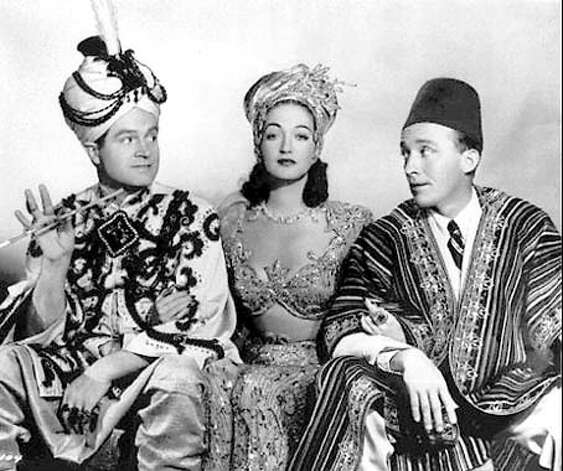
This is what we would nowadays call a 'buddy picture', featuring two wise cracking smart-alecs cruising around the countryside, trading insults, laughing and trying not to get killed. (In this case, there's singing too). The most similar modern film I can think of is Shanghai Knights with Jackie Chan and Owen Wilson.

The cool thing about getting your buddy flick fix in the classic era, is that you get all the humor of the buddy picture without all the raunchy stuff they put in them these days.  This film is not just hilarious, but very family friendly too. ...with the one caveat that it is not particularly socially sensitive. Cultural stereotypes abound, and there is a bit where mental retardation is made fun of. I know that's not cool, and we had a nice conversation with the kids about how the standards for what is OK to make fun of have changed over time, but still...  These elements did not feel offensive, because the movie is so light-hearted and happy go lucky, and because our main characters spend just as much time skewering themselves as anyone else. It was clear that the whole movie was delightfully fun to make.

The movie is so packed with snappy dialogue and one-liners that we "had" to watch it twice just to hear everything :)  The chemistry between Bob Hope and Bing Crosby is tremendous. We talked about how Crosby was predominately known as a singer (who was also funny) and Hope was predominately a comedian (who also sang). Hope has extraordinary comic timing. If you haven't seen him lately, or haven't seen him in his prime, then you need to watch this film.

And I don't want to leave out Dorothy Lamour who costarred in all the "road" pictures with the guys -- and is talented, funny and charming.

Iconic Shot:


Pride of the Yankees (1942)

Why it's here:
Baseball player Lou Gehrig was an inspirational athlete and an iconic figure; this movie about his life, starring Gary Cooper, was highly acclaimed in its time and still well-regarded.

Specs:
Just over two hours, black and white

Our family's average rating on a scale of 1-10:
8.0

More about the film and our reaction to it:
The film is good primarily because Gehrig, an athlete worthy of hero status, has a powerful, touching and very sad life story. Gehrig was a massively talented and popular player on the New York Yankees, playing ball in the 1920s and 30s. He was known as The Iron Horse for his amazing streak of simply going to the park and playing the game, day after day after day for years on end. For over 2100 days in a row -- a matter of 16 years -- he played every ballgame. He even played on the day he got married. Caring and upstanding, a good man and a great ballplayer, he is the kind of hero America would be lucky to have more of.

His story is a love story too and the movie traces his relationship with his supportive wife and their flirty, friendly love. In addition to the skill and the love, there is the tragic piece of his debilitative disease that prevents him from playing ball (and ultimately takes his life, though the movie ends with him very much alive after giving his famous "luckiest man on the face of the earth" speech).  It is a moving moment and if you watch this film, prepare for tears (probably your own).

Gary Cooper's performance as Gehrig (the man) is wonderful, though it's been criticized for not being athletic enough to give a sense of Gehrig-the-ballplayer. Its true he doesn't seem to bring love of baseball to the role (the way, say, Kevin Costner does in Field of Dreams); but ultimately baseball is more of a backdrop to this story -- the real importance is Gehrig as a man, and Cooper nails that. His performance of the speech scene is so excellent, it is almost as good to watch as the footage of Gehrig's actual speech.

The movie may suffer a bit from lack of focus, pulling in a bit too many odd little details and it also drags on a bit long. It is too flawed to say its a "great movie," but we have no problem saying it is a "great story" and is therefore definitely worth watching.

Iconic shot:

Friday, August 24, 2012

Casablanca (1942)

Why it's here:
Few classic films are better known or better made. Cassablanca represents a perfect moment in cinema that should be experienced.

Specs:
About 2 hours, black and white.

Our family's average rating (on a scale of 1-10):
8.0

More about the movie and our reaction to it:
If there is anything more beautiful than Ingrid Bergman's face, I certainly have not seen it. All I need to know about the world of romantic love and tension can be read in it. Her relationship and chemistry with Humphrey Bogart are so strong that they steal my heart without effort; in fact, I imagine they could get to the heart of pretty much anyone who watches -- kids included. There is no question that the power of this movie is the underlying romance.

But the even cooler thing, is that Casablanca goes far beyond romance to pull in its audience. Full of intrigue that will grab your family from the beginning, its an exciting picture about war and politics, with fabulous uniforms, nationalities, threads of international politics and patriotism. The characters are nuanced enough that you can't always tell who to root for. Thus, its an accessible plot that makes you feel adult when you watch it.

My kids love Peter Lorre (who we also enjoyed in the Maltese Falcon) as a strangely exciting and eccentric character and were thrilled to also see Sydney Greenstreet again. Among the film's stellar performances is that of Claude Rains as a kinda funny, cool, unknown entity. And once again, Bogart plays an extremely cool main man -- someone you can't tear your eyes from and whose every move seems important. He is fabulous.

As with pretty much all old movies, there's lots of drinking and smoking -- and plenty of seedier topics. The nice thing with old movies, is that the seedier aspects of life are glossed over and nothing is too explicit; although a great deal may be implied. And also, as with many old films, the one-liners are awesome. The kids laughed aloud at lines like "round up the usual suspects" and "'this gun is pointing at your heart' 'that's my least vulnerable spot.

Iconic shot:

Tuesday, August 21, 2012

Maltese Falcon (1941)

Why it's here:
Suggested by a friend as a must see for our festival. Boy was she right.

Specs:
1 hr 40 minutes, black and white. Available on dvd

Our family's average rating on a 1-10 scale:
8.5

More about the film and our reaction to it:
There's something about star power. Regardless of the era, regardless of the genre, regardless of color, black & white, sound or silence, and regardless of whether you are 10 or 40, you know it when you see it. And Humphrey Bogart had it. The man just controlled the screen. His voice, his smile, his cool demeanor and great hats...all adds up to one sweet gumshoe.

This film was mesmerizing and compelling, even though we didn't always follow the clever plot,; we were spellbound by the drama. Its enough to say this is your basic detective story. Murder, intrigue, twists and turns, satisfying conclusion and, by the end, a wish that this were a series rather than a single movie. Because you just can't get enough of lines like "he's so full of holes he couldn't have gone far," "when I slap you you'll take it and like it," "keep on riding me and they're gonna be picking iron out of your liver," or the classic "I couldn't be fonder of you if you were my own son. But if you lose a son its possible to get another. There's only one Maltese Falcon."

Talented actors fill the cast - Mary Astor gives an incredibly interesting and believable performance as the apparently distraught sister who hands Bogart's Sam Spade the case and then turns out to be much much more. Fabulous Sydney Greenstreet is the big man sitting back and pulling all the strings. But most of all, the boys loved Peter Lorre as the wheezy-voiced, tightly-wound, nevertheless polite gangster Joel Cairo, with whom Spade has some tremendous interactions.

Iconic shot:

Monday, August 20, 2012

The Lady Eve (1941)

Why it's here:
To include something from Barbara Stanwyck. This was directed by Preston Sturges and was supposed to be hilarious

Specs:
Hour and a half, black and white. Available on dvd

Our family's average rating on a scale of 1-10:
6.63

More about the film and our reaction to it:
Though billed as a screwball comedy, this one really wasn't laugh aloud funny or charming to us. Although there were some funny parts, the movie had the overarching theme of card sharps taking our sympathetic hero for a ride. Worse still, Barbara Stanwyck's character spends much of the movie stalking Fonda to torment him, with vengeful and cruel motives. These don't add up to side-splitting humor any more than say, Glenn Close in Fatal Attraction did (and no, that's not on the list).

The movie was well-made, obviously, and the performances were good throughout -- leading us to appreciate the talent behind the movie, its just that none of us really liked it all that much. On top of that, because the film delves into unpleasantries in romantic relationships and spends a good deal of time at the beginning with seductive and passionate interactions that might be a little much, we really wouldn't recommend it for family viewing.

One clear highlight of the picture that needs mentioning though was Stanwick's glorious wardrobe, designed by superstar Edith Head.

Iconic shot:

Sunday, August 19, 2012

Citizen Kane (1941)

Why it's here
Often spoken of as the best film ever made, Citizen Kane seemed to be an important film to put on the list.

Specs:
About 2 hours, black and white, available on dvd

Our family's average rating on a scale of 1-10:
7.25

More about the movie and our reaction to it:
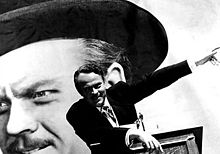
Well here we are, at what is probably the most acclaimed classic of all time. Orson Welles' masterpiece, molded upon the life of William Randolph Hearst, and thereby incurring Hearst's ire and campaign of mass negative publicity until the film struggled to simply get seen. This amazing backstory, in heady shades of detail that I won't even try to get into, is so fascinating it almost rivals the film for dramatic appeal.

Almost. There was no doubt while we watched this film that we were watching something simply,  palpably and profoundly well made. We are not experts and we don't have the background and terminology to explain what makes it so good. But even to laypeople like us, you can just tell when you're watching greatness. Citizen Kane was clearly made by someone who had a profound vision for the story he was telling.

If I knew what I was talking about, I'd speak of the editing choices, the way the shots were framed, the use of shadow and symbolic light, the cutting back and forth through different timeframes, the specific use of sound effects - echoes, bird squawks, yelling, whispering; the miraculous ability of the makeup team to convincingly age our lead man, the way the plot unfolds though interviews, the complex characterization of Charles Foster Kane, his various relationships, and his depressing, tortuous descent. But luckily there is really no need for me to do this. It is clearly complex and artfully made. . . the question is: should you and your family watch it?

As a family film choice, kids under about 13 are unlikely to respond to the movie. Kids above that age might -- but even then, it is probably not a safe bet. With such intelligent, grown-up themes and a plot that is intricate and made harder to follow by the constant moving back and forth through time, this would not be the easiest film choice for families. But, that said, my family did get a lot out of the film. We all admired the work, though its hard to say that the kids enjoyed it. They were, however, moved and saddened by the fascinating ending and were certainly able to take away from the film the sense that what caused this very powerful rich man the most regret and longing were thoughts of his empty childhood. That message is such a good one for young people to see.

Iconic shot:


The Philadelphia Story (1940)

Why it's included:
Directed by George Cukor and starring not just Katherine Hepburn and Cary Grant, but Jimmy Stewart as well. What's not to love.

Specs:
About 2 hours, black and white. Available on dvd. Our library had a copy

Our family's average rating on a scale of 1-10:
8.33

More about the film and our reaction to it:
I do get star-struck, I can't lie. Halfway through the movie I was sitting there watching Katherine Hepburn, Cary Grant and Jimmy Stewart sharing the screen and felt giddy and goose pimply. Here were three enormous talents with enough star power to light up the sky for a week, together in a smart, sophisticated, beautifully filmed production. It is really almost more than words can get around.

This is a brilliant picture -- in the bright sparkly wonderful sense of the word. I've seen it several times and wanted to share it with my kids, but after having done so, I do have to say that on the whole this might not have been the best movie choice for families.  The film really is over the head of most kids with its adult themes (divorce, philandering husbands, heavy social drinking and its after-effects, the intrusiveness of the press, blackmail, etc. etc.) not to mention its witty, ironic tone. But the performances are wonderful throughout and one of our favorites was the 13 year old actress, Virginia Weidler, who played Hepburn's little sister in a charming and very funny way. The humor in the film is more grown up and glittering, than some of the screwball comedies we've been watching of the era, so we appreciated a slightly different style of movie.

While both of my kids liked the movie, their 11 year old friend who was over only gave it a "3"! My kids are a bit more used to classics and already knew the three leads from other film appearances, which always adds to the experience, but overall, it is probably less accessible for family viewing than some others we've watched.

That said, it is cool that shortly after watching this, we caught a reference to the film in an episode of the TV show Phineas and Ferb! "My she was yar!" is a line exchanged a couple of times as the characters reminisce over their happier days on a yacht designed by Grant's character CK Dexter Haven. ("Yar" meaning particularly well-built, seaworthy and fine.) We spent a fair amount of time discussing the idea of "yar". So we nearly swallowed our gum when Phineas said the same about about an ocean liner he'd just built for his friend: "My she's yar!" An homage to The Philadelphia Story for sure. One of the neatest things about watching classics has been noticing that references to classic film is all around us in pop culture.  We are pretty sure that most other viewers of Phineas and Ferb did not pick up on this one.

Iconic shot:

Saturday, August 18, 2012

The Grapes of Wrath (1940)

Why it's included:
We wanted to see Henry Fonda at various stages of his long career. The Grapes of Wrath -- a wonderful adaptation of a poignant novel -- was a perfect choice. My only concern was weather the kids could handle the pain of the Great Depression and the power of the movie's themes. The answer was 'yes'.

Specs:
Just over 2 hours, black and white. We watched on a dvd from the local library.
The film is set during the Dust Bowl

Our family's average rating on a scale of 1-10:
8.33

More about the film and our reaction to it:
This is an extremely powerful and well made movie about an important and very real topic in American history. Although it is probably better suited to the 12+ crowd, for its themes, my 10 year old got a lot out of it too.

For any one who doesn't know, the film, based on the John Steinbeck novel of the same name,  opens with Tom Joad (Fonda) getting out of prison and returning home to find his family and neighbors in the throes of the dust bowl in Oklahoma. Sharecroppers, they are forced off their land by wealthier landowners attempting to put more acreage under mechanized farming. The Joads move west toward what they hope will be greener pastures, in response to advertising pamphlets that have overstated the land of opportunity that is California. The story chronicles their difficult journey west and the conditions of life they meet and endure once there.

This is beautifully acted, directed and photographed. The landscapes are so starkly gorgeous, they are highly evocative. The performances of Henry Fonda and Jane Darwell, as Tom's mother are simply phenomenal and director John Ford, has a clear knack for how to just back off and tell a story. This makes for an exceedingly heart-wrenching and moving tale that will give your kids a powerful understanding of what was going on in our country at this time. We highly recommend it -- but only for those who can handle these themes.
The film ultimately has an uplifting message of hope and fighting injustice (with Henry Fonda's famous "I'll be there" speech to his mother at the end), but there's no getting around the idea that the movie is a serious downer.

Iconic shot: