Why it's here:
Actually we'd seen the Jackie Chan version and loved it. It made sense to view the original film from the 50s.
Specs:
Nearly 3 hours, color; available on dvd
Our family's average rating:
7.63
More about the film and our reaction to it:
As I sit here writing this, the rest of my family is watching the Jackie Chan version (again). They wanted to compare the two. While both are star-studded with cameos and give a wonderful feel of world travel and adventure and contain roughly equivalent overall entertainment value, one thing's for sure: Chan's version is much more hilarious... and juvenile.
We all really liked them both. But the 1956 one, is much more like a grand adventure story, that is also funny, than the rip roaring silliness of the more recent one. The 1956 film takes on the story with a bit more intention and seriousness. Though still light and fun, it feels like "real" cinema. In fact, it feels very much like cinema for grown-ups: an impressive and lengthy production with incredible world travel and sweeping production values.
Shot on location all around the globe, the film usually inspires gushing about the wide screen format employed -- which seems to be the technological equivalent of The Hobbit's recent foray into superfast frames per second -- that is, on a nerdo-scale of excitability. But, since all the movies we watch just basically just fill up my tv set, the insanely-wide screen dimension had little effect on us. What we did love was the feeling of a book brought to life with great lushness and attention to detail.
The kids were thrilled and we were all surprise to see Buster Keaton pop up in a cameo as a train conductor. He was, as always, fabulous. There were so many celebrity cameos, its hard to know which to point out. Some of the more impressive (to me), besides Keaton, were Marlene Dietrich, Frank Sinatra, Red Skelton, and Peter Lorre, but that's just the tip of the iceberg.
This was great fun - but families should be warned it is long and probably not the best choice for those who are new to classic cinema.
Iconic image:
Read our reviews, recommendations, and commentary on classic movies. All with an eye toward family viewing.
Showing posts with label Buster Keaton. Show all posts
Thursday, February 28, 2013
Thursday, December 27, 2012
Limelight (1952)
Why its here:
Kismet. A few days ago, I learned that this was Chaplin's last American/major film and the only one in which he worked with Buster Keaton. As luck would have it, we happened to be watching films from 1952 just as I made that discovery, so we decided to add it!
Specs
Just over 2 hours; black and white. We had trouble finding this one. It was not available for rental on Amazon or iTunes and (unusually) our library did not have it. We watched on Youtube in a very low quality version.
Set in 1914-1917
Our family's average rating on a scale of 1-10:
7.5
More about the film and our reaction to it:
Just a note about the version we watched -- We had to resort to Youtube and unfortunately what I could find was pretty low resolution. Worse still, it was divided into 9 segments, so we had to keep loading and clicking to see it all. Then there's even more bad news: the first segment of the 9 had been removed from Youtube! So, we filled in the first 10 minutes or so with another version that had the dialog overdubbed in Russian, which, I got to tell you, was an odd thing indeed.
Even with these strikes against our viewing experience, we still found the film to be riveting. It grew on us the more we watched, as we became more comfortable with the style of story being told .... which, though Chaplin, is not comedic. An aging, washed-up clown who saves the life of a young very depressed ballet dancer creates a poignant, sometimes humorous, and mostly philosophical drama -- and an excellent one at that.
Chaplin and Clair Bloom were perfect in the lead roles. And the great bulk of the film relies on their skill. I've heard criticism that Bloom overacts in the part of the dancer. While there were a few moments that felt overdone, these seemed to me to be by director's choice to highlight her struggle and not ill-suited to this melodramatic person/story. Her acting suited the character and their relationship (as scared and scarred people who become pillars for each other) suited the film.
I really want to watch (and listen) again in some version of quality in order to take notes on the dialog. Especially in the beginning when Chaplin's character Calvero was giving life advice to Bloom's Thereza. There are spectacularly philosophical bits of advice that would make great sound bites -- worthy of greeting cards, and facebook, and whatnot : ) Calvero is a top-notch friend with an incredible ability to be helpful but not cloying, overdone, or self-important. It is no wonder that Thereza falls in love with him.
And, on that topic, for once, a Hollywood May-December romance is handled well. Probably 40 years separate these two in age, but the implications of this age difference are not ignored. They form a central tenant of the film. The nuanced and difficult relationship makes perfect sense, and the film explores the core meaning of what it is to love and to care and to be grateful. ... And where all of that fits into the notion of romantic love. It is a beautiful theme and really well-handled.
I mentioned Keaton as part of the reason we watched, but his role here is very small. Still, it is the highlight of the film to see Keaton and Chaplin together - still very funny, still silent geniuses. The act they do together is almost entirely without words and is wonderful.
A side note on the time period. we were thrilled to see a movie set in this time that actually felt like the proper era. (Compared to Easter Parade and even Singin' in the Rain, this felt very authentic as a period piece). The apartment, the landlady, the cars, the theater, the relationships, the food -- everything -- seemed spot on. Which makes sense given that between 1914 and 1917 Chaplin was making films with backdrops such as these and clearly knew whats what.
The film is of further interest for the backstory regarding Chaplin. We've been talking with the kids about the Hollywood red scare and blacklisting that arose in response to our nation's fervor to rid the country of Communist influences. A sad and disturbing chapter in the festival is the way the film industry was subjected to the heavy hand of politics, via the House UnAmerican Activities Committee, as the spectacle of the cold war reared in the late 1940s and early 1950s. Some were blacklisted, and many frightened and/or silenced. Those with liberal-leaning views (regardless of whether they were actually communist), were affected. Chaplin became persona non grata at the time of this film. Although some say Chaplin was "deported", in fact, it seems that when he left the country to promote his film abroad, his reentry visa was denied -- amounting to much the same thing. In any case, Chaplin did not return to the States until many years later, in the mid 1970s, when he accepted a lifetime acheivement Oscar.
Iconic shot:
Friday, July 13, 2012
Steamboat Bill Jr. (1928)
Why it's here:
Yes, OK, another Keaton film. But don't give me a hard time about it, because this is (unfortunately) our last.
Specs:
Just over an hour long and absolutely packed with wonderfulness. Black and white. Silent. We saw it on Netflix, but it is easy to find on Youtube and other sources.
Our family's average rating (on a scale of 1-10):
8.63
More about the film and our reaction to it:
This movie is the height, the absolute apex of charm. Pitting rough, river-rat dad and his dandy of a son whom he has not seen for years, Keaton has chosen a theme that has been subsequently and continually worked for laughs by many over the decades. Buster's endeavor in 1928 may not have been the first to attempt it, but it certainly has to be one of the best.
Gruff dad, played beautifully by Ernest Torrence, does not do the best job masking his disappointment at how his son has turned out, but he tries to make the relationship work. That is, if by 'make it work' you mean 'force Bill Jr. into being a more suitable son.' Buster is perfect as the foppishly cute, childishly stubborn, but basically moldable son. He follows dutifully as dad pulls him along by the hand. He gamely lets dad call the shots on mustache- and ukulele- removal, as well as clothing and hair readjustment, but when he runs into his college girl friend (who unfortunately happens to be his dad's arch-rival's daughter), he draws the line. Buster's not giving up King's daughter (played deliciously by Marion Byron) and who can blame him; She is the cutest, spunkiest, gamest costar for Buster that I've ever seen. Her talents suit his well and their scenes together are a joy.
The father/son pairing is extremely well done and forms the heart of the movie. Complications due to dad's underlying feud, disappointment with his son and eventual jailing keep the plot humming along until the final 10 minute sequence which includes the most jaw-dropping barrage of nonstop stunts I've ever seen. No expense could have been spared during scenes of the town's destruction in a fierce tornado-like storm. The insanity culminates in the stunning scene where Keaton allows a house front to fall on top of him, just gliding over him by the slimmest of margins before crashing hard into the ground. From all accounts, this was entirely real -- with a several ton house front and a upper story window designed to give just inches of clearance around our main man. Buster could easily have been killed had anything gone awry.
Iconic shot:
Yes, OK, another Keaton film. But don't give me a hard time about it, because this is (unfortunately) our last.
Specs:
Just over an hour long and absolutely packed with wonderfulness. Black and white. Silent. We saw it on Netflix, but it is easy to find on Youtube and other sources.
Our family's average rating (on a scale of 1-10):
8.63
More about the film and our reaction to it:
This movie is the height, the absolute apex of charm. Pitting rough, river-rat dad and his dandy of a son whom he has not seen for years, Keaton has chosen a theme that has been subsequently and continually worked for laughs by many over the decades. Buster's endeavor in 1928 may not have been the first to attempt it, but it certainly has to be one of the best.
Gruff dad, played beautifully by Ernest Torrence, does not do the best job masking his disappointment at how his son has turned out, but he tries to make the relationship work. That is, if by 'make it work' you mean 'force Bill Jr. into being a more suitable son.' Buster is perfect as the foppishly cute, childishly stubborn, but basically moldable son. He follows dutifully as dad pulls him along by the hand. He gamely lets dad call the shots on mustache- and ukulele- removal, as well as clothing and hair readjustment, but when he runs into his college girl friend (who unfortunately happens to be his dad's arch-rival's daughter), he draws the line. Buster's not giving up King's daughter (played deliciously by Marion Byron) and who can blame him; She is the cutest, spunkiest, gamest costar for Buster that I've ever seen. Her talents suit his well and their scenes together are a joy.
Iconic shot:
Wednesday, July 11, 2012
The General (1926)
Why it's here:
Usually considered Buster Keaton's best work. And often hailed as the best movie of the silent era.
Specs:
1 hr and 45 minutes. Black and white, silent. Available on Youtube and other free sources, though we watched it on a dvd from the Library.
The film is set in the Civil War era.
Our family's average rating (on a scale of 1-10):
More about the film and our reaction to it:
Heralded as the next best depiction of the Civil War ever recorded -- second only to Matthew Brady's photographs -- The General views like a documentary, a comedy and an action adventure film rolled together. Layered over exciting scenes of Buster chasing down enemy soldiers who have stolen his engine (the 'General'), are a sweet story of love (for his girl and for the train) and a simple story of a man who rises to the occasion that duty calls for him.
Keaton spends most of the movie running... around, in, under and atop two civil war era steam trains. The trains are so enlivened by his clear love and attention that they become movie characters themselves. But the best character is of course Keaton's -- Johnny Grey, who spends the movie alternating between doing things that show incredible strength and skill, with things that feel pitiful. He walks a balance figuratively and literally that is astonishing. In one striking example, the renegades have thrown a long heavy wooden railroad tie onto the track to derail their pursuer. Keaton runs ahead of his train in an attempt to dislodge the tie. He manages to do so at the last moment, tugging it free and falling into the cow sweep. With barely a moment to rest, he sees another tie lodged halfway across the track just ahead. With precision that astounds, he heaves the first down onto the other hitting it like a see saw whereupon the whole thing springs to life and off the tracks -- not without nearly smacking him dead in the face first. Shots such as this cannot have been 'faked'. Real logs. Real movie star. Real train. Moving. Real precision. Yet our hero conveys as much awkwardness as skill in having done it, takes it in stride and climbs back into the engine to stoke the fire before the next disaster.
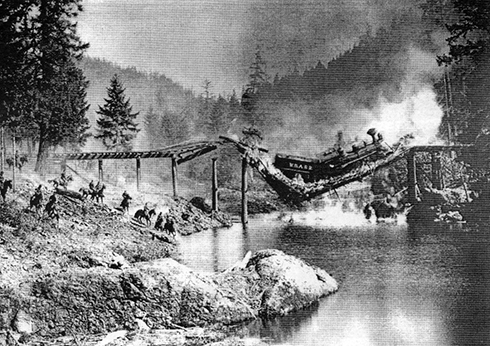
The stunts come fast and furious (including one so stunning it still shocks: the sight of the (real) steam train "Texas" collapsing a burning bridge and plunging into the river below). Underlying the whole is a movie with so much heart that it makes yours ache.
Iconic shot:
Usually considered Buster Keaton's best work. And often hailed as the best movie of the silent era.
Specs:
1 hr and 45 minutes. Black and white, silent. Available on Youtube and other free sources, though we watched it on a dvd from the Library.
The film is set in the Civil War era.
Our family's average rating (on a scale of 1-10):
8.5
More about the film and our reaction to it:
Heralded as the next best depiction of the Civil War ever recorded -- second only to Matthew Brady's photographs -- The General views like a documentary, a comedy and an action adventure film rolled together. Layered over exciting scenes of Buster chasing down enemy soldiers who have stolen his engine (the 'General'), are a sweet story of love (for his girl and for the train) and a simple story of a man who rises to the occasion that duty calls for him.
Keaton spends most of the movie running... around, in, under and atop two civil war era steam trains. The trains are so enlivened by his clear love and attention that they become movie characters themselves. But the best character is of course Keaton's -- Johnny Grey, who spends the movie alternating between doing things that show incredible strength and skill, with things that feel pitiful. He walks a balance figuratively and literally that is astonishing. In one striking example, the renegades have thrown a long heavy wooden railroad tie onto the track to derail their pursuer. Keaton runs ahead of his train in an attempt to dislodge the tie. He manages to do so at the last moment, tugging it free and falling into the cow sweep. With barely a moment to rest, he sees another tie lodged halfway across the track just ahead. With precision that astounds, he heaves the first down onto the other hitting it like a see saw whereupon the whole thing springs to life and off the tracks -- not without nearly smacking him dead in the face first. Shots such as this cannot have been 'faked'. Real logs. Real movie star. Real train. Moving. Real precision. Yet our hero conveys as much awkwardness as skill in having done it, takes it in stride and climbs back into the engine to stoke the fire before the next disaster.
The stunts come fast and furious (including one so stunning it still shocks: the sight of the (real) steam train "Texas" collapsing a burning bridge and plunging into the river below). Underlying the whole is a movie with so much heart that it makes yours ache.
Iconic shot:
Labels:
1920s,
Buster Keaton,
genre: comedy,
silent film
Sherlock Jr. (1924)
Why it's here:
I'd heard of Buster Keaton but hadn't seen anything of his and wanted to include him in the festival. With a bit of research, this title rose to the top of the pile -- I thought that with its dream-theme, movie within a movie, and spy story, it ought to be perfect. I was right. But I was so much more right than I could have ever dreamed. The movie blew us away.
Specs:
45 minutes, black and white silent. Available on Netflix, you can also find it on Youtube
Our family's average rating (on a scale of 1-10):
More about the film and our reaction to it:
Without wanting to overstate the point, this film changed my life. My kids and husband really enjoyed it too, but for me, well, it (and Keaton) took over my head heart and soul.
As I mentioned in an earlier post, we added some of his earlier work and a couple more features to our festival after encountering him in this one, but this one was the first and will probably always be my favorite. Sherlock Jr. is profoundly interesting and well made. When you have a lot of experience watching movies (as we do now) and are plumbing the depths of 90 year-old work to fill up your summer, you just don't really expect that many surprises. But Sherlock Jr. surprises. It actually astounds.
Our hero is known simply as "the Boy." He's unskilled but confident. He works as a projectionist but he has hopes of being a detective. Keaton gives a great nuanced performance -- imbuing the Boy with longing, shyness, the desire to step up and be a man, and an overarching fear of failure. He's so timid with his girl that he can't look at her when he gives her a ring. But he fearlessly tracks his suspect all around town when framed by his rival for the theft of a watch. There's great acting, great comedy touches (like Keaton's hilariously walking in lockstep with the suspect), and clever vaudeville visual stunts. The pacing is brisk and perfect, the locations transportative, and there are sweet little details like having "the Girl", played by Kathryn McGuire, actually solve the crime herself in a matter of minutes while Buster is out bumbling around.
All this comes together to make the film complete and engaging, but the real punch is packed by its technological wonders. When the Boy gets back to his projector and starts the afternoon's show, he dozes off. Several amazing things start to happen. A hazy second-self wakes up, fractions off from the Boy, and walks away. He steps through the audience and orchestra and into the playing movie, with in-camera effects that are so well done that they look beautiful, convincing and evocative even in 2012.
What makes these scenes remarkable is not that Keaton was able to achieve them, technically speaking, but that he was able to weave them, artfully, into a story where they actually matter. When the Boy enters the picture and attempts to interact, he is expelled from the action. He doesn't belong. An astonishing editing sequence shows Buster in the middle of the scene as the movie continues to shift around him -- the background becoming a garden, a rocky outcrop, a jungle, a desert and a snow bank, etc. The effort involved in piecing together this nearly seamless sequence was massive. And it's beautiful work. But what makes it mind-blowing is that it is used to further the story. Not until he finds a role he can dream himself into, can Buster enter the movie. So when the bad guys on screen concoct their nefarious plot, Buster finally enters the make believe world as smooth, suave, Sherlock Jr.
At this point the technological thrills give way to more slapstick ones, including my favorite, Buster riding on the handlebars of a motorcycle after the driver has been kicked off. Cars, puddles and men with shovels can't unseat him as he speeds along through the streets of LA and deftly past the still undeveloped hills of Southern California.
The movie, at just 44 minutes, is a fast and furious ride that we highly recommend taking.
Iconic shot:
I'd heard of Buster Keaton but hadn't seen anything of his and wanted to include him in the festival. With a bit of research, this title rose to the top of the pile -- I thought that with its dream-theme, movie within a movie, and spy story, it ought to be perfect. I was right. But I was so much more right than I could have ever dreamed. The movie blew us away.
Specs:
45 minutes, black and white silent. Available on Netflix, you can also find it on Youtube
Our family's average rating (on a scale of 1-10):
8.25
Without wanting to overstate the point, this film changed my life. My kids and husband really enjoyed it too, but for me, well, it (and Keaton) took over my head heart and soul.
As I mentioned in an earlier post, we added some of his earlier work and a couple more features to our festival after encountering him in this one, but this one was the first and will probably always be my favorite. Sherlock Jr. is profoundly interesting and well made. When you have a lot of experience watching movies (as we do now) and are plumbing the depths of 90 year-old work to fill up your summer, you just don't really expect that many surprises. But Sherlock Jr. surprises. It actually astounds.
Our hero is known simply as "the Boy." He's unskilled but confident. He works as a projectionist but he has hopes of being a detective. Keaton gives a great nuanced performance -- imbuing the Boy with longing, shyness, the desire to step up and be a man, and an overarching fear of failure. He's so timid with his girl that he can't look at her when he gives her a ring. But he fearlessly tracks his suspect all around town when framed by his rival for the theft of a watch. There's great acting, great comedy touches (like Keaton's hilariously walking in lockstep with the suspect), and clever vaudeville visual stunts. The pacing is brisk and perfect, the locations transportative, and there are sweet little details like having "the Girl", played by Kathryn McGuire, actually solve the crime herself in a matter of minutes while Buster is out bumbling around.
All this comes together to make the film complete and engaging, but the real punch is packed by its technological wonders. When the Boy gets back to his projector and starts the afternoon's show, he dozes off. Several amazing things start to happen. A hazy second-self wakes up, fractions off from the Boy, and walks away. He steps through the audience and orchestra and into the playing movie, with in-camera effects that are so well done that they look beautiful, convincing and evocative even in 2012.
What makes these scenes remarkable is not that Keaton was able to achieve them, technically speaking, but that he was able to weave them, artfully, into a story where they actually matter. When the Boy enters the picture and attempts to interact, he is expelled from the action. He doesn't belong. An astonishing editing sequence shows Buster in the middle of the scene as the movie continues to shift around him -- the background becoming a garden, a rocky outcrop, a jungle, a desert and a snow bank, etc. The effort involved in piecing together this nearly seamless sequence was massive. And it's beautiful work. But what makes it mind-blowing is that it is used to further the story. Not until he finds a role he can dream himself into, can Buster enter the movie. So when the bad guys on screen concoct their nefarious plot, Buster finally enters the make believe world as smooth, suave, Sherlock Jr.
At this point the technological thrills give way to more slapstick ones, including my favorite, Buster riding on the handlebars of a motorcycle after the driver has been kicked off. Cars, puddles and men with shovels can't unseat him as he speeds along through the streets of LA and deftly past the still undeveloped hills of Southern California.
The movie, at just 44 minutes, is a fast and furious ride that we highly recommend taking.
Iconic shot:
Labels:
1920s,
Buster Keaton,
genre: comedy,
silent film
Tuesday, July 10, 2012
Buster Keaton's shorts (1920 - 1923)
Why it's included:
Because we collectively fell in love with Buster Keaton after watching a couple of his features and realized we needed to sample some shorts too. We ended up watching them all -- and, although we'd recommend the whole pile, we think the best ones for families are The High Sign and The Scarecrow.
Specs:
Length varies, usually about 20 minutes, all black and white silents.
Our family's average rating (on a scale of 1-10):
7.17 The Scarecrow
7.5 The High Sign
More about the film and our response to it:
Buster Keaton shorts are awesome -- especially the ones that were under his complete creative control. From 1920 to 1923, Keaton made almost 20 short comedies -- starring in, writing and directing them. He had the kind of creative genius that is hard to explain to modern people because we are so inclined to be condescending about the past. I don't speak of his genius in that remote, distant way people speak of things that are good for you, but in a way that honors vibrant, real, accessible brilliance that is still profoundly good.
These films make perfect family viewing because they are funny and because kids of any age can appreciate the amazing physical comedy of Keaton. Almost all his films have an upbeat positive feel, even though his characters are often down on their luck. The message, if you can call it that, is usually to keep plugging away despite adversity. His comedy is never mean-spirited and although it's called "slapstick", isn't the kind of poking in the eye, hitting with pie sort of antics we've come to associate with that word. There is a clear intelligence and subtle irony that plays throughout these films.
The two we're singling out are The High Sign and The Scarecrow. They may not be his best, artistically speaking, but they are both very funny, easy to watch, and include really cool intricate mechanical devices that will capture your kids' imagination and make them want to start building stuff.
Iconic shot:
Labels:
1920s,
Buster Keaton,
genre: comedy,
silent film
Saturday, July 7, 2012
Coney Island (1917)
Why it's here:
We were looking to include something from the Fatty Arbuckle/Buster Keaton comedy team. This was a good choice because it contains incredible shots of Coney Island in 1917. Actually, this movie manages to kill several birds with one stone as it also allows you to introduce your kids to the Keystone Cops (Kops?).
Specs:
About 25 minutes, black and white, silent, and easy to find on Youtube.
Our family's average rating (on a scale of 1-10):
More about the film and our reaction to it:
I gotta 'fess up. I stuck this film into the list at a later date. When I first put our festival together I didn't really care about Buster Keaton or Fatty Arbuckle, nor did I have any reason to want to see them together. It wasn't until after we watched Sherlock Jr. (1924) and were blown away by the talent of Keaton, that it seemed an important to beef up on his career.
By discovering Keaton, I also discovered Arbuckle -- his talent, his role in giving Keaton a start, and the true story behind Arbuckle having been falsely accused of a crime (see that story in another post). Speaking of Keaton's start in films, it came in 1917, when he visited Arbuckle's New York film studio and was given the opportunity for a small part in the Butcher Boy. Keaton was a natural. Arbuckle immediately put him on his comedy team where they made about a dozen short films together before going their separate ways (cinamatographically) though remaining close friends for life.
Coney Island, one of their earlier collaborations, is enjoyable for a lot of reasons, not the least of which is being able to see Keaton smiling, laughing, and clapping in an animated way, before he adopted his famous deadpan style. Fatty is very funny in this as well, beginning with an opening scene where he's playing with sand on the beach in such a childish way that my kids felt sure that the woman next to him must be his mom (rather than his wife.) I'd have been happy to let them persist in that belief since he subsequently ditches her and runs around after a young woman, but the screen titles told the truth.
Anyway, their onscreen pairing is charming and the whole thing fun in a juvenile way. This is s a film that you probably won't need to pull teeth, or explain the importance of, in order to get your kids to watch it with you.
Iconic shot:
We were looking to include something from the Fatty Arbuckle/Buster Keaton comedy team. This was a good choice because it contains incredible shots of Coney Island in 1917. Actually, this movie manages to kill several birds with one stone as it also allows you to introduce your kids to the Keystone Cops (Kops?).
Specs:
About 25 minutes, black and white, silent, and easy to find on Youtube.
Our family's average rating (on a scale of 1-10):
7.0
I gotta 'fess up. I stuck this film into the list at a later date. When I first put our festival together I didn't really care about Buster Keaton or Fatty Arbuckle, nor did I have any reason to want to see them together. It wasn't until after we watched Sherlock Jr. (1924) and were blown away by the talent of Keaton, that it seemed an important to beef up on his career.
By discovering Keaton, I also discovered Arbuckle -- his talent, his role in giving Keaton a start, and the true story behind Arbuckle having been falsely accused of a crime (see that story in another post). Speaking of Keaton's start in films, it came in 1917, when he visited Arbuckle's New York film studio and was given the opportunity for a small part in the Butcher Boy. Keaton was a natural. Arbuckle immediately put him on his comedy team where they made about a dozen short films together before going their separate ways (cinamatographically) though remaining close friends for life.
Coney Island, one of their earlier collaborations, is enjoyable for a lot of reasons, not the least of which is being able to see Keaton smiling, laughing, and clapping in an animated way, before he adopted his famous deadpan style. Fatty is very funny in this as well, beginning with an opening scene where he's playing with sand on the beach in such a childish way that my kids felt sure that the woman next to him must be his mom (rather than his wife.) I'd have been happy to let them persist in that belief since he subsequently ditches her and runs around after a young woman, but the screen titles told the truth.
Anyway, their onscreen pairing is charming and the whole thing fun in a juvenile way. This is s a film that you probably won't need to pull teeth, or explain the importance of, in order to get your kids to watch it with you.
Iconic shot:
Subscribe to:
Posts (Atom)